Understanding the Differences Between PET and rPET: A Buyer’s Guide
Choosing between PET and rPET packaging is no longer just a materials decision – it’s a key lever in meeting sustainability commitments while maintaining performance and reliability. For B2B buyers navigating regulatory pressure, cost control, and operational demands, understanding how PET and rPET differ in real-world applications is essential.
Below, we highlight the considerations that matter most when specifying containers and closures for professional use.
What Is PET? The Performance Standard Buyers Trust
PET (Polyethylene Terephthalate) is a durable plastic from the polyester family – the same group of materials used in textile fibres. When used for packaging, PET is specifically engineered to deliver strength, clarity, and consistency.
At MPS, our PET packaging is manufactured using Injection Stretch Blow Moulding (ISBM), a process that produces containers that are:
- Lightweight, helping to reduce transport costs and carbon emissions
- Crystal clear, providing a premium, glass-like appearance on the shelf
- Virtually unbreakable, improving handling efficiency and consumer safety
These qualities make PET an excellent choice for high-speed filling lines and large-scale distribution, aligning with the key priorities of procurement and operations teams.
What Is rPET? Recycled Content with Growing Industrial Maturity
rPET (recycled PET) is produced by collecting post-consumer PET, reprocessing it through washing, flaking, and re-polymerisation, and converting it back into food-grade resin.
From a sustainability standpoint, rPET delivers clear advantages:
- Significantly reduced carbon footprint versus virgin PET
- Alignment with EU circular economy legislation
- Support for brand-level recycled content commitments
Technically, modern rPET – when sourced and processed correctly—can meet the same intrinsic viscosity (IV) requirements as PET, making it suitable for blow-moulded containers with standard neck finishes.
PET vs rPET: Key Differences That Matter to Buyers
- Material Consistency and Supply Chain Reliability
PET offers predictable availability and batch-to-batch consistency. rPET availability, however, is influenced by:
- Collection rates
- Recycling infrastructure
- Regional/council recycling capacity
- Filling Line Performance and Operational Efficiency
From an operational perspective, properly specified rPET containers can run efficiently on existing filling lines. That said, certain factors require attention:
- Higher rPET content can introduce minor variations in colour consistency
- Resin variability may influence stretch behaviour during injection stretch blow moulding if not tightly controlled
Experienced manufacturers address these challenges through process optimisation, targeted preform design adjustments, and rigorous incoming material qualification. The result is containers that maintain dimensional accuracy and reliable neck finish performance.
For buyers, this means rPET does not need to result in increased downtime – when supported by the right technical expertise.
- Appearance and Performance Considerations
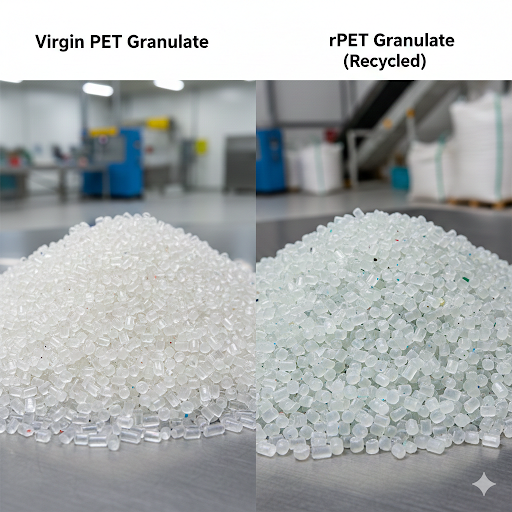
PET typically delivers crystal-clear transparency. rPET may show a subtle grey or ‘smoky’ appearance depending on recycled content levels.
For many B2B applications—especially industrial, foodservice, or sustainability-led brands—this visual difference is acceptable or even desirable, reinforcing recycled content claims without compromising functionality.
Material Selection: Not a Simple Either/Or
For many buyers, the optimal solution is not choosing PET or rPET – but defining the right blend strategy:
- 30-50% rPET to balance sustainability and consistency
- 100% rPET where regulatory approvals and performance allow
- Virgin PET for technically demanding or appearance-critical SKUs
MPS can assist in testing the different blends to suit your requirements.
Talk to MPS
If you’re evaluating PET or rPET containers and closures, the MPS team is ready to support you with samples, technical consultations, and tailored quotations. Get in touch to explore solutions that meet your operational needs while supporting your sustainability goals.
Email: sales@mps-europe.com
Telephone: 01670 522003